AI Development Company vs In-House Team
Share this blog:
60 Second Summary
You approved the AI budget six months ago. The pilot looked promising. And it's still not in production.
If that sounds familiar, you're not alone. Most enterprises don't get stuck on the technology. They get stuck on one decision nobody wants to own: build an AI team internally or bring in a partner who's already done this fifty times.
And this isn't a small decision.
Whether you build a team or hire a development partner, you're looking at $50,000 to $500,000 a year in AI investment and a choice that decides how fast you can move for the next three to five years.
Pick wrong, and you're either rebuilding a team that never worked out or stuck with a vendor who never understood your business.
If you want to know what both mean and which is better for your business, this blog is for you.
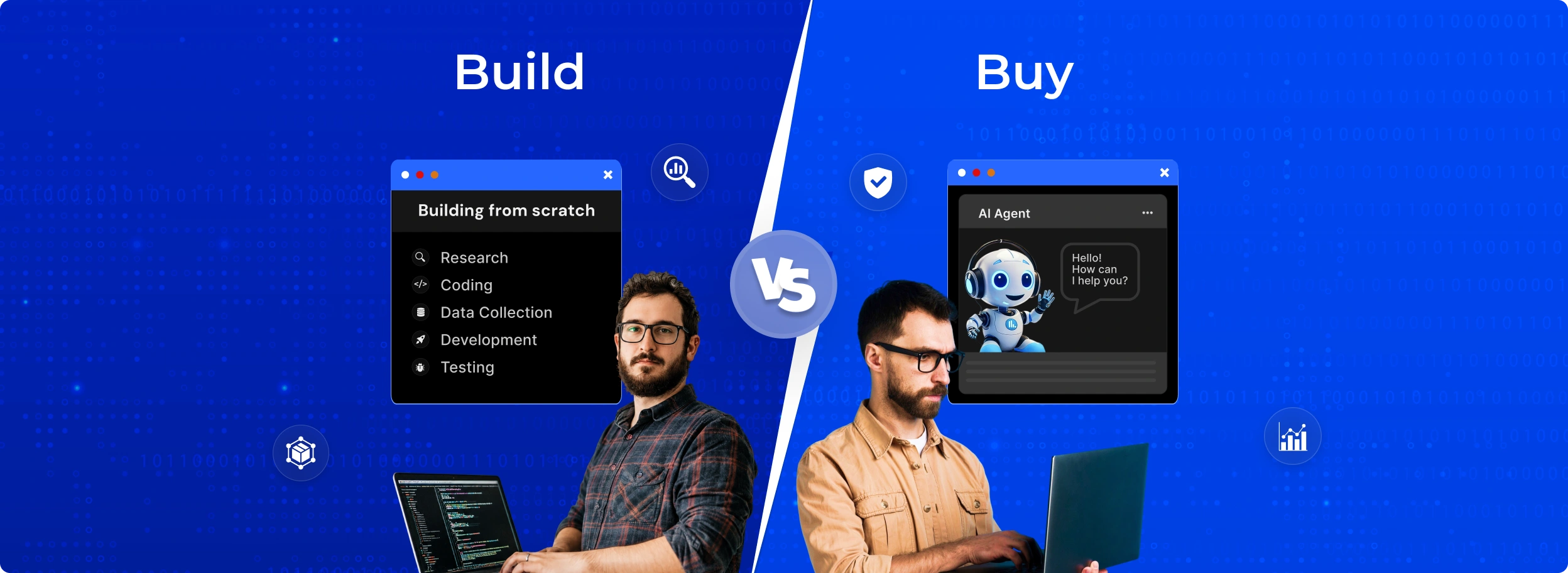
Choosing between an AI development company and an in-house AI team isn't just about cost; it's about:
An in-house AI team gives you complete ownership and control over AI development, while an AI development company provides immediate access to experienced specialists who can design, build, and deploy AI solutions without the time and expense of hiring an internal team.
Here's a quick breakdown of both approaches.
Basis of Comparison | In House Team | AI Development Company |
Control | Full control over everything, like the team's work and the decision-making process. | Don't have much control because the consulting firm handles the decision-making part. |
Expertise | Highly focused on your specific day-to-day business domain. | Cross-industry expertise, access to diverse specialists without hiring them. |
Cost | Higher upfront cost (recruiting, infrastructure, salaries). | Lower cost since you pay for the services you need. Flexible pricing depending on the project scope. |
Scalability | Low scalability due to hiring cycle | Easy to scale up/down depending on project scope |
Time to get started | 4-9 months to get a team hired. | A few weeks to get the prototype ready. |
Business Alignment | Aligns with your internal business processes as the in-house AI team has a deep understanding of your organization, culture and business objectives | Needs onboarding to learn your workflows and understand your business, processes and goals. |
Best For | Best for enterprises building long-term capabilities and core products | Ideal for fast-moving startups, MVP development and budget-conscious AI projects. |
Data security | Full control but only as strong as your internal security practices. | Depends entirely on the partner. Ask for SOC 2, HIPAA or GDPR compliance before signing |
Access to Latest AI tech and tools | Limited by how much your team can upskill while managing day-to-day operations. | AI development companies usually upskill themselves and update their tech stack. |
Risk of burnout | An in-house team might feel overwhelmed, especially if they're handling multiple projects. | A dedicated development team doesn't feel burnout because they're hired to focus on a specific project and to reduce the workload of your internal staff. |
Maintenance | In house team typically does it as part of their job. | AI development company typically offers maintenance as a support service. |
Customization | AI solutions can be tailored to your company's culture and business needs. | AI development teams bring specialized expertise, but they may not always be customizing solutions as per the company's culture. |
An in-house AI team involves hiring data scientists and ML engineers who understands infrastructure well enough to keep models running in production.
They own the hiring, tooling, cloud spend, and the roadmap. These professionals work exclusively on your project, align with the company’s culture, and build the AI solution that aligns with the company’s objectives and business processes.
Airbnb CEO Brian Chesky plans to launch a new AI lab, focused on improving how the app handles travel search, discovery, and the overall user interface.
His reasoning is straightforward: existing LLM products weren't ready for the kind of experience he wants to build, so he skipped an off-the-shelf partnership entirely.
The goal, as he's described it, is an app that understands you well enough to help plan an entire trip, not just point you to a listing.
Choose in-house teams only if:
A few drawbacks make an in-house approach the wrong fit for some businesses:
Building an in-house team can be very expensive. As per Indeed, the average salary of a data scientist in the US starts at $130,706 per year.
But this is just the starting point because if you keep adding more data scientists, project managers and MLOps engineers, cost is likely to increase.
And such costs won't stop, and they keep on multiplying due to other expenses such as training, software and infrastructure.
Creating an AI solution from scratch isn't an overnight process. Recruiting, onboarding and getting a new team productive can easily take 4 to 9 months before real work begins.
Similarly, gathering quality data, building and validating models, and model performance can take months.
And if your internal team has limited bandwidth, it may slow down your business-critical projects.
Even if you've a talented team of AI engineers and data scientists, every day new AI skills rise, so if your team doesn't have a niche expertise in NLP, MLOps, and LLMs, they won't be able to build an AI solution on their own.
Instead of hiring AI specialists one by one, an AI development company takes a different route. They already have the people, the tools, and the playbook, and you pay them for outcomes, not for hires.
Consider it like this:
Companies like BigOhTech are examples of AI development companies because they’ve worked across multiple industries and use proven frameworks, tools and best practices to deliver tailored solutions. They’ve done this before, just for a different client this time.
They carry the infrastructure and compliance for you that would otherwise take your first 6 months if you built it in-house.
Choosing an AI development company is a profitable option for you if:
Here are 5 main reasons why you need to outsource AI development services to a tech vendor instead of building internally:
Partnering with an AI development agency is like getting to work with skilled developers who bring their niche capabilities in areas like Machine learning, NLP, Deep learning, data engineering, etc that would otherwise be expensive to hire or hard to find.
For example, Pearson partnered with Cognizant to bring Agentic AI and generative AI capabilities into their learning assessment platforms. They wanted to create transformative learning solutions for both educators and learners.
By leveraging the capabilities of Cognizant’s technology capabilities, Pearson now has a suite of interactive learning products designed as per the learning styles and preferences of audiences.
An AI development company comes with predefined workflows, tools, reusable components and playbooks that reduce the development time by half.
This means they can quickly move from idea to execution like a minimum viable product without moving through long hiring processes.
The outsourced partner will take care of the technical side of things while you can focus on doing product launches.
Example: SIGNAL IDUNA, a leading German insurer, wanted to improve customer service as agents had to manually search through more than 2,000 internal documents covering over 600 insurance tariffs.
This time-consuming process meant that 27% of customer inquiries had to be escalated to specialists, delaying resolutions and impacting customer experience.
To speed up its AI transformation,
using Google's Gemini models and Vertex AI.
The solution enables service agents to search thousands of internal documents using natural language, helping them find accurate information much faster.
When partnering with an AI development company, you’re paying for the project scope, which is more affordable than hiring a full-time team and paying them salaries and other benefits such as health insurance, bonuses, office equipment, and infrastructure costs.
This keeps your cost predictable since you’re paying for the outcomes delivered.
For enterprises in regulated industries like healthcare, finance, insurance, or legal services, outsourcing AI solutions to an external vendor means gaining a secure, auditable AI system.
It comes backed by compliance expertise and governance frameworks that would otherwise take months or years to build in-house.
Instead of spending months hiring AI engineers and data scientists, businesses can quickly access cross-functional AI teams to scale their AI initiatives faster and move from pilot to production based on changing project priorities
.
Lufthansa reached out to us with a problem that had been dragging on for a while.
Their compliance and maintenance documentation ran on outdated technology. Categorizing records for audits was almost entirely manual; someone on their team was sorting through paperwork that should have taken minutes, not hours.
Hiring a dedicated internal team meant months of recruiting before a single line of code got written. In an industry like aviation, regulatory risk also makes trial and error genuinely expensive.
We designed and deployed a system to automate the categorization work and get their audits ready faster.
Customer onboarding dropped from four to five months to just one.
That's the difference between losing a quarter of revenue to paperwork and actually bringing in new business during that time.
Outsourcing doesn't always beat building in-house. But when your timeline is tight and your industry doesn't forgive mistakes, working with a team that's already solved this exact problem elsewhere is worth more than the control you'd get from building it yourself.
Internal Team Owns | External Partner Handles |
Product Vision | AI engineering |
Business Knowledge | MLOps |
Governance | Development |
Strategic decisions | Scaling |
The right approach depends on your business goals, internal capabilities, budget and the speed at which you need to deliver AI solutions.
A few questions worth asking, like:
Business Need | Best Option |
Build proprietary products | In-house |
Launch AI products quickly | AI Development Company |
Limited AI expertise or talent shortages | AI Development Company |
Long term AI Research | In-house |
Need specialized skills immediately | AI Development Company |
Enterprise-wide AI transformation | AI Development Company |
Most businesses go with the way where they start with the partner first, then build the team as you grow.
There's no universal right answer here. If AI is a long-term strategic bet and you have the resources to build and keep specialized talent, an in-house team pays off over time.
If speed, proven expertise, and predictable costs matter more right now, an AI development partner gets you there faster.
And if you want both strategic ownership and to avoid slowing down delivery, the hybrid model is worth a serious look. This is exactly where BigOhTech fits into the picture.
We don't ask you to hand over your whole AI strategy; we plug in as the engineering, MLOps, and deployment muscle behind whatever your internal team is already building, so you keep control of the vision without spending a year hiring for skills you may only need once.
If you're weighing this decision right now, a free AI strategy session with our team is usually enough to see which path, in-house, partner, or hybrid, fits where your business is today.
If speed, specialized AI expertise, and faster ROI are your priorities, partnering with an AI development company is often the better choice.
If AI is a core business capability and you're investing in long-term innovation, building an in-house AI team offers greater control and stronger long-term returns.
For most startups, partnering with an AI development company is more cost-effective than hiring a full AI team. Once the product gains traction, you can gradually build internal AI capabilities.
Yes. Many enterprises use a hybrid model where internal teams define the product vision while the AI development company handles engineering, deployment, and specialized AI expertise.
Choosing a vendor based solely on cost can lead to poor outcomes. Instead, evaluate technical expertise, security standards, industry experience, and post-launch support.
Define ownership of source code, AI models, documentation, and data before the project begins. A clear contract and knowledge transfer plan help maintain long-term control.
For many enterprises, yes. A hybrid model combines your team's business knowledge with an AI development company's technical expertise, helping you deliver AI solutions faster while retaining strategic control.
For many enterprises, yes. A hybrid model combines your team's business knowledge with an AI development company's technical expertise, helping you deliver AI solutions faster while retaining strategic control.
IP ownership depends on the contract. In most enterprise engagements, clients retain ownership of custom AI models, code, and data, while the development company may retain rights to its proprietary tools or frameworks.
Choose a partner with proven enterprise AI experience, relevant case studies, expertise in technologies like LLMs and RAG, and strong security practices. Also evaluate their delivery process, communication, and post-launch support.
Building an in-house AI team ranges from $220,000 to $300,000 per year. The total cost varies based on team size, expertise, and location, making it a significant long-term investment.
It can be if the partner follows the same standards, you'd hold an internal team to. Look for zero-trust architecture, role-based access control, and compliance with whatever regulations apply to your industry.
If your goal is to validate an idea, launch an MVP, or automate non-core workflows, partnering with an AI development company typically delivers faster ROI.
Building an in-house AI team offers stronger long-term returns when AI is a core business capability and you're investing in continuous innovation.
Yes, in most cases. Outsourcing AI development helps businesses avoid the high costs of hiring, training, and retaining specialized AI talent while providing faster access to experienced AI engineers.


•
Sr. Technical Writer•
Articles