Agentic AI in Banking: Revolutionizing Financial Services in 2026
Share this blog:
60-Second Summary
In 2026, the question for banks is no longer "Are you digital?" It is "How autonomous can you become?"
"After many years of investment in analytics, automation, and AI, most financial institutions have made a striking realization: traditional AI helped them analyze; generative AI in fintech helped institutions create content, automate customer interactions, and improve service delivery; neither one helped them act on their own."
In this blog, we will explore the 10 core use cases, the 7 critical challenges, and a complete 4-step roadmap for deploying Agentic AI in your institution.
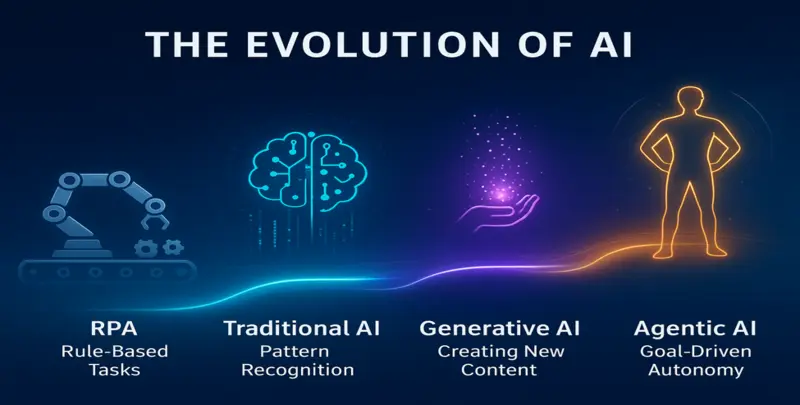
The simplest way to think about Agentic AI is as a progression of traditional automation.
The user does not have to define all instructions in an Agentic AI system. For example, we present a mission like Investigate this suspicious transaction or Approve loans less than 50000, provided risk is within limits.
The agent identifies the actions necessary to accomplish the mission, which can involve drawing data, validating risk models, reasoning, and executing the decision, and can interact with other AI agents or APIs. Fundamentally, every Agentic AI system operates based on the Perceive → Reason → Act loop.
These agents do not operate as fixed AI models; they learn as they go, make decisions based on their results, and refine their reasoning patterns.
In banking, this development is directly translated into quantifiable results:
Traditional AI is rule-based. Agentic AI makes them.
Agentic AI doesn't simply follow algorithms or instructions; it thinks, reasons, and acts independently to achieve objectives. It is aware of the environment, considers it, and makes choices before it even acts, acting like a human analyst, but with digital speed and scale.
According to Accenture's 2026 Global Banking Report [1], over 48% of Tier-1 banks have launched pilot programs using Agentic AI frameworks to automate multi-step financial services processes, such as KYC, AML monitoring, and loan adjudication. The results have been astounding:
According to Gartner, by 2028, 33% of enterprise applications will feature Agentic AI, a significant leap from less than 1% in 2024. [2]
Report Features | Description |
Market Value (2024) | USD 5.2 Bn |
Forecast Revenue (2034) | USD 196.6 Bn |
CAGR(2025-2034) | 43.80% |
Leading Segment | 66.4% |
Largest Market | North America [38.0% Market Share] |
Largest Country | U.S. [1.58 Bn Market Revenue], CAGR: 43.6% |
We are on the cusp of a future where AI won't just support bankers; AI will become part of the workforce. By the year 2030, you can expect to see the following:
Agentic AI is emerging as one of the top fintech trends shaping the future, alongside embedded finance, real-time payments, and intelligent automation across financial services.
As technology gets better, early adoption of Agentic frameworks will give banks a competitive advantage in speed, trust, and innovation.
Banking executives are no longer just optimizing; they're facing a breaking point. The complexity of the system, rising regulatory costs, and escalating customer demands are making traditional automation obsolete. Below are the three fundamental pressures that are mandating a strategic pivot, moving the industry toward the strategic autonomy of agentic AI.
Banking has become a multi-layered digital ecosystem: between legacy core systems and cloud-native applications, to APIs and integrations with third-party applications. Human supervision of this degree of complexity is no longer viable. Autonomy on a large scale, Agentic AI can monitor, reason, and respond more quickly than any human team. This evolution in AI in financial services marks a pivotal shift toward autonomy.
The pressure on margins is increasing, regulatory costs are rising, and compliance expenses are increasing exponentially. The compliance cost is almost 20 percent [3] of the average bank's operational budget. Much of that, including constant monitoring and the creation of observations and reports that meet auditors' and regulators' requirements, can be automated by agentic AI.
Customers are now demanding intelligent, 24/7 interaction that is either contextual or personal. Beyond AI-driven personalization, technologies such as AR/VR in banking and financial services are helping institutions create immersive customer experiences, virtual banking environments, and interactive financial advisory solutions.
The agentic systems can forecast customer intention, provide hyper-relevant financial advice, and play a proactive role by alerting customers to an overdraft or a superior loan rate, without human intervention.
All these forces are collectively forcing banking executives to rethink the concept of digital transformation, highlighting how AI powers digital transformation through strategic autonomy rather than isolated automation initiatives.
The conversation in banking is shifting from simple automation to adopting next-gen banking technology. While traditional AI offers efficiencies, agentic AI delivers proactive, 24/7 decision-making that traditional systems lack. These use cases range from dynamic fraud detection to autonomous portfolio management, addressing the industry’s toughest challenges.
Traditional fraud detection systems are reactive and static, while financial crime is very dynamic and adaptive. Banks usually rely on fixed rules; if a crime occurs, then these rules will be activated
For example, if a fraudster withdraws over $10,000 from Bangladesh, then the bank will instantly flag the transactions.
But fraudsters are also good at their game, finding the loopholes in these rules, and they are continuously changing their attacking patterns. fraudsters can make 100 transactions of $9,999 from 100 different accounts.
In this scenario, an AI Transaction Agent can detect an anomaly, even though the transaction amounts do not exceed the given rules. It sees a pattern that a human would miss.
Many of these fraud prevention capabilities are built on advances in machine learning in banking, where models continuously learn transaction patterns and identify anomalies that traditional rule-based systems often miss.
It is close to impossible to detect sophisticated threats hidden within the large volume of daily communications and transactions.
An AI agent can run 24/7, continuously monitoring all relevant data streams to connect subtle signals across different systems and stop crimes before they happen.
The current loan process is slow, expensive, and fragmented. It depends on multiple manual human interventions. For organizations exploring how to build a fintech app, streamlining loan origination and approval workflows is often one of the highest-priority use cases
This manual, multi-day process is expensive for the bank and frustrating for the customer.
A Single Agentic AI acts as the "digital loan officer, underwriter, and funder" all in one. It can manage the entire process from end to end, connecting the customer and the bank's core system
Old credit scoring, like FICO, is static, backward-looking, and incomplete. It has multiple issues that ruin the relationship between the customers and banks. It rejects high-quality customers, just because the bank failed to see real-time cash flow and high income.
It unfairly penalizes many creditworthy people, like recent graduates, immigrants, or small business owners. This is where an Agentic AI can be life lifesaver, building on a living, real-time risk profile.
It can continuously take dynamic data and analyze sources like daily cash flow, transaction history, payroll deposits, and open-banking data, to understand a customer's financial health, not just their past, demonstrating the growing role of artificial intelligence in finance.
Manual portfolio management is quite slow, emotionally driven, and inefficient, which can cause the client’s portfolio's asset mix and drift away from the client's actual financial goals and risk tolerance.
For example, A portfolio set at 60% stocks and 40% bonds can easily become 75% stocks during a bull market. This drift can cause the client to face far more risk than they agreed to.
Instead of having periodic manual reviews, an Agentic AI can monitor the client's portfolio and the live market 24/7. It will follow a clear objective of maintaining the exact ratio it is instructed, for example, Maintain a 60/40 stock/bond allocation.
You can also add specific rules, like If any asset class drifts by more than 5%, rebalance immediately. It will act autonomously to execute the best trades to return the portfolio to its target.
This drift can cause the client to face far more risk than they agreed to.
Private wealth management is built mainly for high-net-worth clients, like someone having over 1 million $ in their accounts, which justifies the high advisory fees.
Agentic AI can break that barrier and act as a 24/7 personal wealth manager, which is going to be scalable for every customer, regardless of their account size. This type of personalization is one example of how Agentic AI solutions can support customer-facing financial services.
Human teams are reactively moving funds at the end of the day, but the agentic AI can continuously and simultaneously move for a 24/7, consolidated view of all the bank's cash across the globe.
It can autonomously predict and meet all the regulatory capital and payment obligations in real-time. With any excess liquidity, autonomously execute overnight swaps and investments to capture the highest possible yield.
Real-Life Example: How Citibank's Treasury AI Could Work
For Example: Citibank's treasury team is preparing for the "end-of-day" close. A manual review shows they have:
Hypothetically, an Agentic AI can monitor this in real-time; it can keep running predictive models. It knows the bank is safe on its $6B regulatory requirement. It now acts on its secondary goal, which is to maximize yield.
As the saying goes, “Shoes that fit you may bite others”. What I mean by that is traditional mass-market banking is impersonal and reactive; it treats millions of customers the same, offering generic products.
It doesn't understand the customer's context. It sends a generic mortgage offer to a 22-year-old just starting their career or a credit card ad to someone actively trying to pay off debt. The bank only "helps" when the customer actively calls them (e.g., to report fraud or ask for a loan). It offers no proactive guidance.
Agentic AI can act as a proactive, 24/7 personal banker that can understand the customer's real-time context. It can integrate all of the bank's data, transactions, goals, browsing history, based on which it can cater to the needs and provide personalized, timely advice and offers. These workflows can be implemented through AI agent development for reporting, documentation, and customer-support automation.
Unlike traditional smart contract security, which is static, manual, and too slow, on the other hand, DeFi Decentralized Finance exploits are dynamic, automated, and executed in seconds.
The most devastating "flash loan attacks" happen within a single blockchain transaction (in less than 15 seconds). By the time a human analyst's dashboard turns red, the hacker has already borrowed $100M, manipulated a price, drained a protocol, and vanished. Human reaction is physically too slow to stop it.
Agentic AI can monitor the blockchain in real-time, specifically the mempool of pending transactions. It can simulate potential attacks before they are confirmed and autonomously intervene in the same transaction block to stop them.
Banks are generating petabytes of data so vast and complex that it has become completely invisible to human analysis, making machine learning in banking essential for extracting actionable insights from large-scale datasets.
The most critical risks and biggest opportunities, however, are not in one system. They are hidden in the correlations between huge, unstructured datasets (like emails, chat logs, call transcripts, market reports) and structured data (like transaction logs).
A human analyst looking for a specific threat, while an AI is given a broad goal, like to analyze everything, all transactions, emails, chats, reports, and find new, high-risk patterns.
The core challenge of agentic AI in financial services is a fundamental conflict: the technology demand for speed versus the industry's need for auditable compliance. Leaders are facing a minefield where a single AI error could trigger a regulatory shutdown, and an unproven tool could corrupt a core database. We explore the major barriers, from the autonomy risk dilemma to adversarial vulnerabilities.
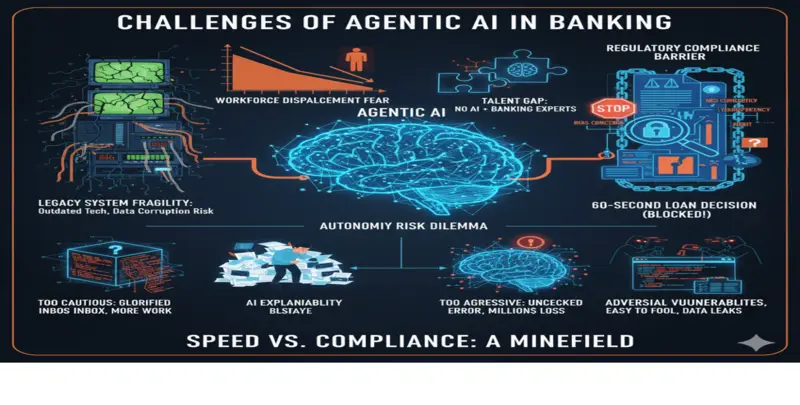
Decades-old legacy systems are so interconnected that even a simple project can unknowingly touch critical infrastructure and result in customers and the company losing its confidential data, just like in July 2025, the AI company Replit's coding assistant deleted a customer's production database during a software development experiment.[4]
We can see it like this: The AML database is a critical, fragile "system-of-record" that is audited by the government. If the new, unproven AI tool accidentally corrupts even one entry in that database, the entire bank could face massive fines and regulatory shutdown.
The issue is the conflict between AI-driven speed and regulatory compliance. Building an Agentic AI to make instant loan decisions risks bias, lack of transparency, and regulatory violations under Fair Lending laws, requiring strict validation and audit controls.
For example, if a small business lending team wants to build an Agentic AI that can review loan applications and give a pre-approval decision in 60 seconds.
The objective is to be the fastest bank on the market to win more clients. To do this, IT needs to give the AI read/write access to the core customer database and the credit scoring system. This is a major integration.
The Compliance Team will immediately step in and stop the project, as how can we prove to a regulator that this AI isn't biased? This could violate Fair Lending laws. We need full model validation and an audit trail before it ever sees a real application.
The core issue here is the legacy system itself, to create a simple task like an AI chatbot for an app that can handle customer requests. 'Check my account balance.' To make that happen, the AI needs to read that data from the customer's account of the API for the Core Banking System.
There is no API. The 'Core Banking System' has been a COBOL mainframe since 1984. It was built for tellers using green-screen terminals. Creating that will become another Mainframe API Gateway project altogether.
Rolling out agentic AI inside a bank is a double-edged sword if the bank is too cautious; every AI decision requires human approval. The AI agent becomes a glorified inbox, creating more work for employees.
On the other hand, if the bank is too aggressive, the AI is allowed to act autonomously. A single hallucination or error, undetected by a human, could lead to a catastrophic, multi-million-dollar mistake (like a fraudulent transfer or locking a CEO's account) in seconds.
Most of the AI decisions are "opaque," meaning the AI cannot explain why it reached a conclusion. This directly violates laws (like the Equal Credit Opportunity Act) that require banks to provide specific, human-understandable reasons for adverse actions like denying a customer a loan. "The AI model decided" is not a legal reason.
In this case, there is no clear way to find out who is legally and financially responsible: the AI vendor, the internal developer who prompted the AI, the business unit that set the goal, or the human who was overseeing things.
One of the biggest issues that isn’t well addressed today is how easy it is to fool AI. Many tech giants are now launching their own AI-powered browsers, but most of them lack one crucial thing: an additional layer of security. This gap is leading to massive data leaks.
People are losing money because they’re assigning key tasks like shopping or ordering groceries to these new browsers. A hacker only needs to inject a single line of code, and the AI agent could end up revealing all of your confidential information.
One Bloomberg Intelligence report estimates that up to 200,000 banking jobs [5] worldwide could be lost within the next three to five years due to AI. Another report by Citi suggests that 54% of banking jobs have a high potential for automation.
This has struck fear into its workforce. Employees view the AI as a direct threat to their job security. They will over-scrutinize its work to find tiny flaws.
On the other hand, some employees will trust the AI too much. They will blindly accept its recommendations without proper review. Lack of the Human-in-the-Loop (HITL) safeguard, exposing the bank to errors that the human was supposed to prevent.
Hiring AI engineers who truly understands banking's complex rules is extremely difficult. A brilliant programmer can build an Agentic AI, but they may not understand the risk of accidentally breaking a core compliance database or violating a fair lending law.
This gap is dangerous. For example, an AI team might build an agent to move bank funds to earn more interest. But by missing one specific banking rule, the agent could trigger a massive regulatory fine.
For banking leaders, successful agentic AI adoption is really crucial in 2025. The following is the clear 4-step roadmap.
Agentic AI sits on top of generative AI, which means trust must be engineered into the architecture from day one. Banks worry about hallucinations and data leakage, designing the agent systems where models run locally, learn only from the bank’s secure data, and provide explainability for every decision they make.
From deployment control to data-based grounding and deep audit trails, trust is a foundational pillar, not an afterthought. With the right guardrails, banks can move from hesitation to confident adoption and begin unlocking value immediately.
”— Varun Goswami, Head of Product Management, Newgen
In a nutshell, an Agentic AI development team should not only be skilled in building AI models but must also understand the critical perspective of risk and compliance.
When building an agentic system, a developer should not only think about its autonomous capabilities but also see how it can be fundamentally trustworthy, secure, and explainable to drive confident adoption and unlock real value.
We know Agentic AI is the key to moving your bank from digitally enabled to digitally independent.
However, we don't build high-risk "black box" agents. As the article highlights, the risks of compliance violations and legacy system failure are too high. Our approach focuses on building auditable, "human-in-the-loop" controls to ensure your agents are safe, explainable, and compliant before they act autonomously.
As an AI development company, our top Agentic AI engineers have a proven record of creating value.
Best part? They don't just do coding. They have a "deep problem-solving approach" and spend their time analyzing your data and unique compliance needs. We offer flexible hiring models to build robust agents that:
Result – You get a flexible, focused team dedicated to building a secure, auditable agentic system that delivers real value, not regulatory risk.
Yes. Scalable modular frameworks let smaller institutions start with limited use cases and expand gradually.
Most pilot projects show visible efficiency or compliance improvements within 60–90 days of implementation.
Yes. When built under strict governance and explainability frameworks, Agentic AI operates safely within regulatory and ethical banking standards.
Not necessarily. Hybrid models allow Agentic systems to operate alongside on-prem and cloud infrastructure, depending on a bank’s digital maturity.
Large Language Models (LLMs), reasoning engines, multi-agent orchestration frameworks, and secure API integrations form the core technology stack.
Generative AI creates content and insights, while Agentic AI can make decisions and take actions autonomously. In banking, Agentic AI helps automate complex workflows such as fraud detection and loan processing.
Common use cases include fraud detection, compliance monitoring, loan processing, risk assessment, portfolio management, and customer service automation.
Agentic AI continuously monitors transactions, identifies unusual patterns, and detects threats that traditional rule-based systems may miss.
Yes. Agentic AI can automate customer verification, monitor suspicious activities, and support compliance teams with faster risk analysis.
Key challenges include regulatory compliance, legacy system integration, explainability, security risks, and governance requirements.


Table of Contents
•
Sr. Technical Writer•
Articles