How Much AI Agent Development Costs in 2026?
Share this blog:
60 Second Summary
Every functional AI head that reached out to us asked us the same question: how much does it cost to build an AI agent for our business? Here’s what we answered: The cost is never the same, as it depends on what you’re trying to build.
Developing a simple agent starts with a pricing range of $40,000, while creating a domain-specific multi-agent orchestration system can cost $500,000 or more than that.
The difference comes down to:
And if you're deploying an autonomous agent in finance or healthcare, budget extra for governance and auditability from day one.
Read this blog to get clarity on the real cost of developing custom AI agents to make smarter business decisions. Plus, we will be sharing some ways to help you optimize your AI development costs because every dollar counts.
There are various criteria based on which you can breakdown cost for building an AI agent. Let's have a detailed discussion over it.
The exact cost for developing an Agentic AI system boils down to what you're creating as every agent differs in autonomy level, tool usage, and infrastructure needs.
Here's the cost breakdown by agent type, and how pricing climbs as complexity goes up.
Agent Type | What are these? | Exact Cost |
Reactive AI Agent | No memory, no planning. It just responds based on whether this happens; do that. Think of this like FAQ bots that respond to simple queries. | $20,000 to $35,000 |
Contextual AI Agent | Remembers the context per session and can handle multi-step conversations or workflows. | $40,000 to $70,000+ |
Autonomous AI Agent | Plans its own steps, coordinates across multiple tools and executes workflows based on real-time feedback. | $80,000 to $120,000 |
Domain specific AI agent | Built for a specific domain like a legal assistant, medical agent or a finance copilot with compliance, proprietary data and accuracy requirements baked in from the very start. | $150,000 to $400,000 |
Utility based agent | Assigns a utility score to each action, evaluates different factors (like cost, satisfaction, efficiency) and chooses the action with the highest value. | $60,000 to $200,000+ |
Learning agent | They don’t just execute; they keep on learning and improving over time based on feedback loops. | $100,000 to $300,000+ |
Goal based agents | Evaluate various possible actions and select the best course of action to achieve specific objectives. | $70,000 to $100,000+ |
Collaborative agents | Collaborate with humans in real time and divide the complex tasks to achieve shared goals. | $100,000 to $500,000+ |
The exact cost allocation depends on the project's complexity, integrations, and business requirements but here's how costs are commonly distributed across enterprise implementations.
Component | % of Budget | What it covers? |
Discovery and architecture | 8-10% | Defining use cases, solution architecture, technical planning and data assessment. |
LLM & Prompt Engineering | 10-15% | Selecting the right AI model, designing prompts, configuring tools and implementing guardrails. |
Backend and integrations | 30-35% | Developing business logic, APIs, authentication, and integrations with systems such as CRM, ERP, or HRMS. |
RAG and knowledge pipeline | 10-12% | Preparing enterprise data, generating embeddings, configuring vector databases and optimizing information retrieval. |
Frontend and user experience | 10-12% | Building chat interfaces, admin dashboards, and responsive user experiences across devices. |
QA evaluation | 8-10% | Functional testing, AI evaluation, prompt validation, regression testing and security checks. |
DevOps and deployment | 5-7% | Setting up cloud infrastructure, CI/CD pipelines, monitoring and production deployment |
The cost of developing an AI agent comes down to a handful of factors like complexity, customization, data requirements, model training, and maintenance.
AI agents run on different types of models, and that choice affects both build and ongoing costs. The model is what lets the agent understand input, reason through context, and generate a response.
Without a model, the agent can't run multi-step chats or deal with unstructured data. And since most model providers charge on a usage-based pricing model, this becomes a recurring cost not a one-time fee that scales with how much the agent is used.
Model | Type | Pricing Model | Average Monthly Cost |
GPT 4o (Open AI) | Hosted API | $5- $30 per million tokens | $1,000 - $8,000+ |
Claude (Anthropic) | Hosted API | $8-$25 per 1 million tokens | $1,500 - $6,000+ |
Mistral (Open source) | Self-Hosted | Infrastructure + maintenance | $800 - $4,000+ |
Llama (Meta) | Self-Hosted | Requires GPU + DevOps | $1500 - $5500+ |
The amount of data your AI agent uses and how it processes the data directly affect your development and infrastructure costs.
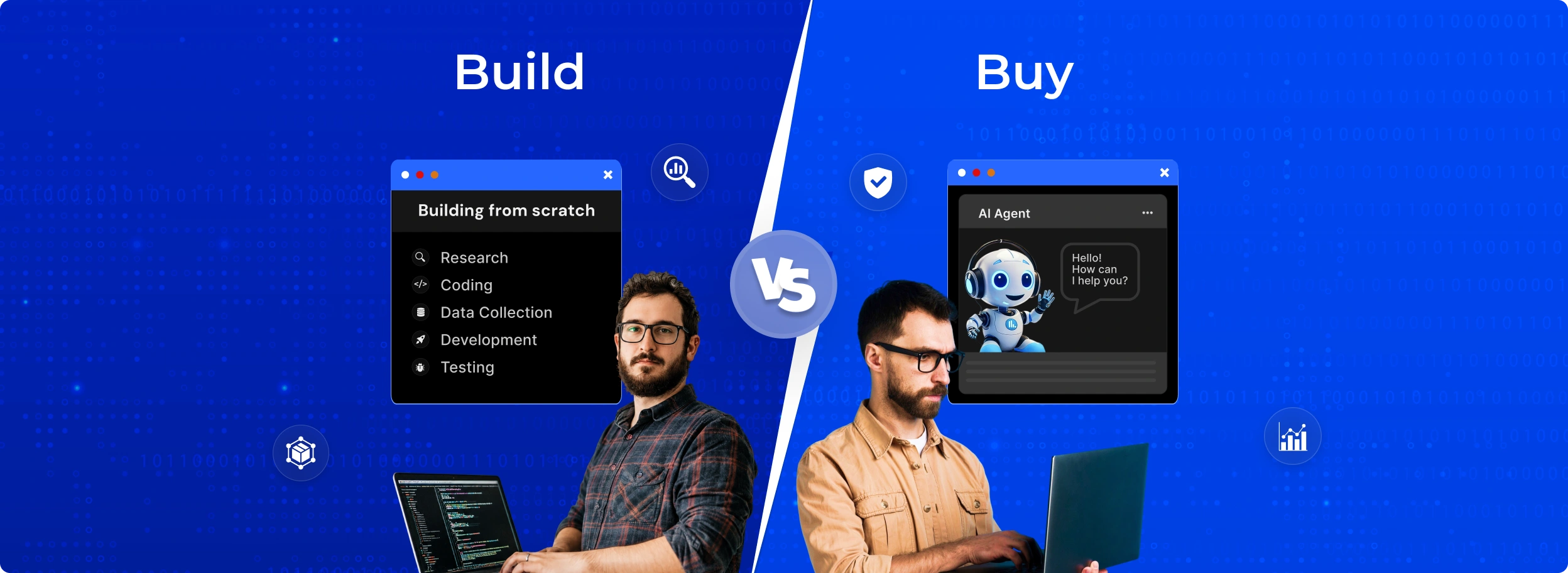
Building an agent in-house vs buying a vendor platform affects your agentic AI development cost.
Note: The choice to switch between custom AI agents and using existing platforms depends on project requirements and budget constraints.
If you’re in healthcare, finance or any other regulated industry, compliance isn’t optional and isn’t cheap to add in later stages of the development process. Things like HIPAA, SOC 2, or GDPR need to be part of the plan, not something you bolt on after the agent is built.
Implementing measures such as data laws and ensuring that your AI system is industry complaint is important to prevent costly rework or regulatory issues.
For example, if you’re creating an AI agent for the EU market, then you need to comply with the EU ACT, 2026; otherwise, it impacts your AI automation strategy and development cost.
The skill level and region where the development team is based also affect your overall development cost.
If you’re hiring seasoned professionals from the US/Western Europe, then it would be more expensive because of differences in labour rates and operational expenses.
At BigOhTech, we’ve a dedicated development team for your agentic AI needs that can meet your resource needs based on project scope and complexity.
Using third-party tools or software can significantly increase the cost of developing an AI software.
Note: Building an AI agent isn’t about developing the application; it involves selecting the right tools, integrating enterprise systems, planning the deployment and preparing for long-term maintenance.
Where you deploy your AI agent also increases your initial development cost.
Once an agent is developed, continuous support is essential for maintaining and scaling it. This ensures that agents will run smoothly and adapt to the changing needs of the enterprise, especially when the agent scales or the number of tasks increases.
The maintenance cost includes:
Speed to market often increases initial development costs.
Here are the key strategies you can implement to optimize AI development costs:
Resist the urge to solve five problems in version one. A focused agent ships faster, costs less, and gives you real usage data before you scale scope.
If you've already got clean, structured data somewhere, use it. Don't recreate work that's already done.
A lighter model that's fast and cheap can outperform a premium model for narrow, well-defined tasks.
Fine-tuning is expensive and often unnecessary. In most cases, retrieval-augmented generation (RAG) gets you most of the way there for a fraction of the cost and saves fine-tuning for when RAG genuinely can't do the job.
Launch to a small group, learn what breaks, fix it, then expand. It's cheaper to fix problems at 50 users than at 5,000.
Don't wait until year one is over to find out if the agent is earning its keep. Set checkpoints and track them from week one.
AI agents drift over time, so what worked well at launch quietly gets less accurate as data and usage patterns shift. Automating that monitoring and retraining process catches the drift early and cuts down on the manual babysitting an agent would otherwise need.
Real-world training can significantly increase AI development costs. Using simulation platforms such as OpenAI Gym or Unity ML-Agents allows teams to train agents more efficiently, reducing costs while improving accuracy.
Outsourcing AI agent development can help you reduce costs, speed up deployment and access specialized expertise without incurring the overhead of building an in-house AI team.
You get to work with skilled AI engineers with proven experience in building and shipping AI agents without the overhead of office space or long-term commitments.
Instead of relying on local hiring, you can work with experienced AI professionals who’ve successfully delivered projects in past.
After working with 250+ functional AI heads from 100+ enterprises in past and working across legal tech, hospitality, energy and trading, we found that enterprises that get this right don’t start by chasing the cheapest route.
They start by scoping one use case properly, understanding what it will cost over 3 years and building an architecture that can expand once that first agent proves itself.
Our team works through the discovery and planning stage before writing a single line of code, so you’re not finding the hidden cost 6 months in. That’s the process behind every agent we ship.
Clients working with us have seen operational costs drop up to 10% and saved up to 7 hrs/ day in manual work.
If you want to know how the realistic budget looks like for your use case, connect with our AI Agent Developers.
Anywhere from $15,000 for a simple assistant to $1,000,000+ for a multi-agent enterprise platform. Most department-level agents land between $40,000 and $150,000.
Anywhere from $10,000 for a simple rule-based agent to $300,000 for a complex multi-agent system. It depends on customization, integration needs, and ongoing maintenance.
ROI shows up as reduced manual work, faster decisions, and lower operational costs. BigOhTech clients have seen up to a 10% reduction in operational costs and up to 7 hours saved per day.
When the workflow involves proprietary data, deep legacy system integration, or industry-specific compliance needs. And when the use case is valuable enough to justify months of development.
Vendor lock-in. Usage-based pricing that climbs as adoption scales. Limited customization if your workflow doesn't fit the platform's settings.
To a point. Most platforms let you configure workflows and connect integrations. But you're still working within the vendor's boundaries. Deep customization usually means building instead.
Buy the foundation: base models, authentication, monitoring infrastructure. Build the custom workflows and business logic that actually differentiate your company.
A basic agent takes 4 to 8 weeks. A full agentic system with machine learning capability takes 6 months to a year.
Healthcare, finance, manufacturing, and energy. Compliance requirements and proprietary workflows are harder to solve with off-the-shelf tools.
Yes, through API connectors and orchestration layers. This is a common integration challenge, especially with legacy systems.
Compare total cost of ownership (development or license costs plus maintenance) against measurable business value: hours saved, error reduction, or revenue impact from faster decisions.
For most organizations, buying AI agents provides faster ROI. Since the solution is already built and tested, implementation is faster, technical risks are lower, and businesses can automate their workflows immediately.
Building an AI agent requires a larger upfront investment in development, integration and testing, but it also offers greater customization and ownership for organizations with unique business needs.
If you don’t have the in-house engineering expertise, then partnering with a custom AI agent development company is the suitable option.


•
Sr. Technical Writer•
Articles