AI chatbots are transforming mobile technology by enabling instant, personalized, and always-on customer support that reduces churn and improves user loyalty.
Companies across ecommerce, banking, hospitality, and insurance use AI chatbots to cut support costs, scale conversations, and boost engagement directly within mobile apps.
AI-powered chatbots enhance customer experience through real-time responses, personalized recommendations, lead qualifications, and guided purchase journeys.
Key challenges include choosing between custom vs off-the-shelf chatbots, balancing cost with scalability, and ensuring seamless integration with existing workflows.
Custom AI chatbot development helps businesses gain full control, advanced personalization, and long-term scalability, making chatbots a strategic growth asset rather than just a support tool.
Have you noticed how today's most successful mobile apps rarely make users wait? In an era where instant responses define customer loyalty, even small delays translate directly into churn and lost revenue.
As mobile usage continues to grow, traditional customer support models are becoming increasingly expensive, slow, and difficult to scale. That’s why companies are prioritizing AI-powered chatbots as a core part of their mobile strategy.
In this article, we will learn about how AI chatbots are transforming mobile applications, the key benefits they offer, and how to decide between a custom chatbot or adopting a pre-built solution.
Why is the Demand for Chatbots Growing Rapidly?
Here's why the demand for chatbots is growing increasingly:
1. Instant Gratification has become a MUST-HAVE
Mobile users have little patience these days and expect instant services, whether it’s checking an order status, booking appointments, or exploring new features.
AI-powered chatbots meet this expectation by resolving user queries in real time, directly within the app. Instant responses not only reduce the reliance on human support teams but also significantly improve customer satisfaction and engagement across mobile experiences.
2. 24/7 Availability Without Support
Even if you scale up your support team to handle growing customer queries, your cost of hiring, onboarding, and training continue to rise. Over time, high workload and stress often lead to attrition, forcing businesses back into the same hiring cycle.
This is where integrating chatbots into mobile apps becomes a game changer. Unlike human agents, AI-powered chatbots don’t get tired, can handle multiple conversations simultaneously, and remain available 24/7.
As a result, no customer query is missed while support costs are reduced, and service quality remains consistent.
3. Enhances Customer Experience
Customers no longer want to feel like just another support ticket, nor do they want repetitive, generic responses. Today, they expect to be heard, understood, and engaged in a more human way.
Deploying AI chatbots in mobile apps makes this possible by enabling personalized conversations at a scale.
These chatbots can understand user intent, respond in context, and deliver tailored product recommendations, helping brands speak the customer’s language while creating more meaningful and engaging experiences.
4. Chatbots Have Become More Accessible Now
With advancements in AI and Machine Learning, creating in-app chatbots is super simple and quick. From using ready-to-use APIs, drag-and-drop bot builders, and API integration, chatbot development has become faster and easier to implement.
How are Chatbot Apps Transforming Mobile Technology?
Here are some benefits that businesses can get by developing an AI chatbot for mobile apps-
1. Act as a 24*7 Support Agent
Chatbots excel at delivering end-to-end customer support by handling user queries continuously, without interruptions. This allows businesses to reduce their dependency on large support teams and significantly lower operational costs.
At the same time, customers no longer have to struggle to find information or products. AI-powered chatbots provide instant, relevant responses, making the overall experience faster, simpler, and more convenient.
2. Increases Customer Engagement
Chatbots hook the customers to spend a longer time on the website as they provide interactive experiences. AI-powered bots take feedback from customers and give them the best possible response, increasing customer engagement rate.
Bain & Company says, "Customers want to spend more money when they can interact with someone on a website or social media." Chatbots replicate this interaction at scale, turning engagement into measurable business value.
3. Increases Business Sales
Chatbots help businesses convert leads into potential customers. Businesses can leverage chatbots by offering discounts, showing the latest product collections, providing customized product recommendations, and pushing visitors down the funnel.
4. Provides Personalized User Experiences
Chatbots provide hyper-personalized recommendations to customers by storing the data. It tracks the user's activities, understands their preferences, and comes up with personalized tips and relevant answers.
5. Increases conversion rates
Chatbots aren't just confined to handling conversations; generating sales for your business is another popular use case.
For example, a lead generation chatbot helps businesses in bringing leads down the funnel, such as answering FAQs, scheduling appointments, sharing product-related information, or offering discounts that nudge prospects to make a sale.
Even some chatbots have become so advanced today that they can qualify prospects and shortlist the hottest leads, which become opportunities for the sales team to close.
6. Make data-driven decisions
Chatbots turn every conversation into useful insights by analyzing customer preferences, pain points, and behavioral patterns.
By understanding customer queries, they can identify the exact loopholes, such as whether UX design was not good or whether offerings require improvement. These insights help the product and marketing teams increase customer satisfaction.
For example, MasterCard uses an AI-powered chatbot called "MasterCard KAI" on their mobile app for customers' tasks such as managing financial transactions, assisting customers in completing payments, and providing support related to handling transaction fees.
If the bot receives maximum inquiries on fees and charges, then it means either customers are not aware of the fees, or the information is not transparent. That becomes a starting point for support, sales, and marketing teams.
Industries Where Chatbots can be Used in Mobile Apps
1. Retail and E-Commerce
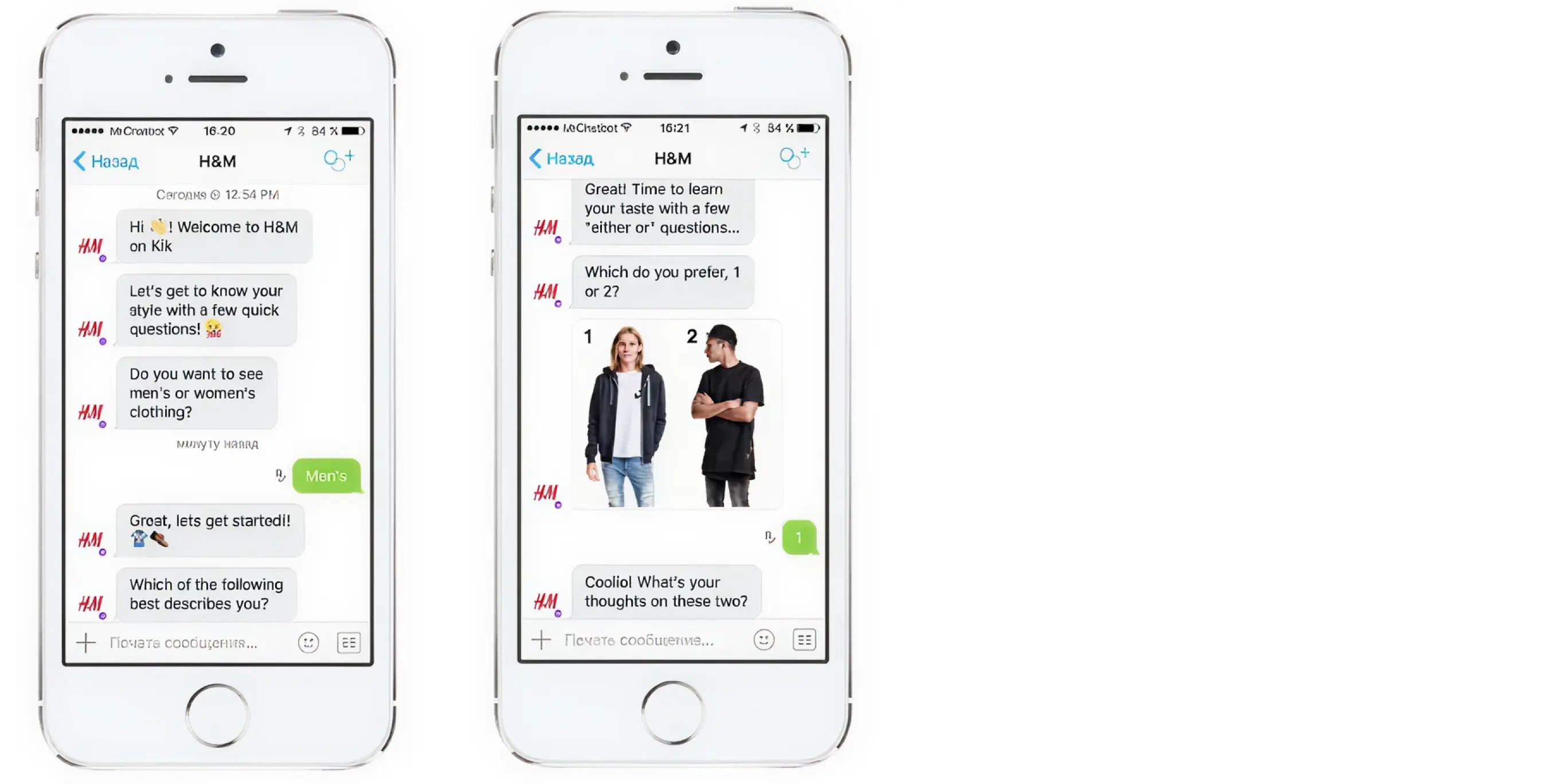
Do you know that e-commerce businesses are growing exponentially? But businesses might end up ignoring one-to-one customer conversations when they have a growing customer base. Here, chatbots are vital in bridging the gap between you and your end user.
Sharing notifications about the product and its prices
Provide regular reminders to customers about the products that have been added to the cart or that they might forget to buy them.
Helping them by providing hyper-personalized recommendations such as guiding the prospect while placing an order and the process involved in making the payment
Providing customer services after customers end up buying products
2. Banking and Finance
Chatbots prove to be a gold mine in the banking and finance sectors. Chatbots can help customers access their personal financial information, help them avail of best-in-class loan services based on their needs and preferences, and share the best investment plans for them.
Chatbot has made the life of customers much more accessible. Chatbots are on-demand personal bankers providing instant responses to customers when needed.
3. Hospitality Industry
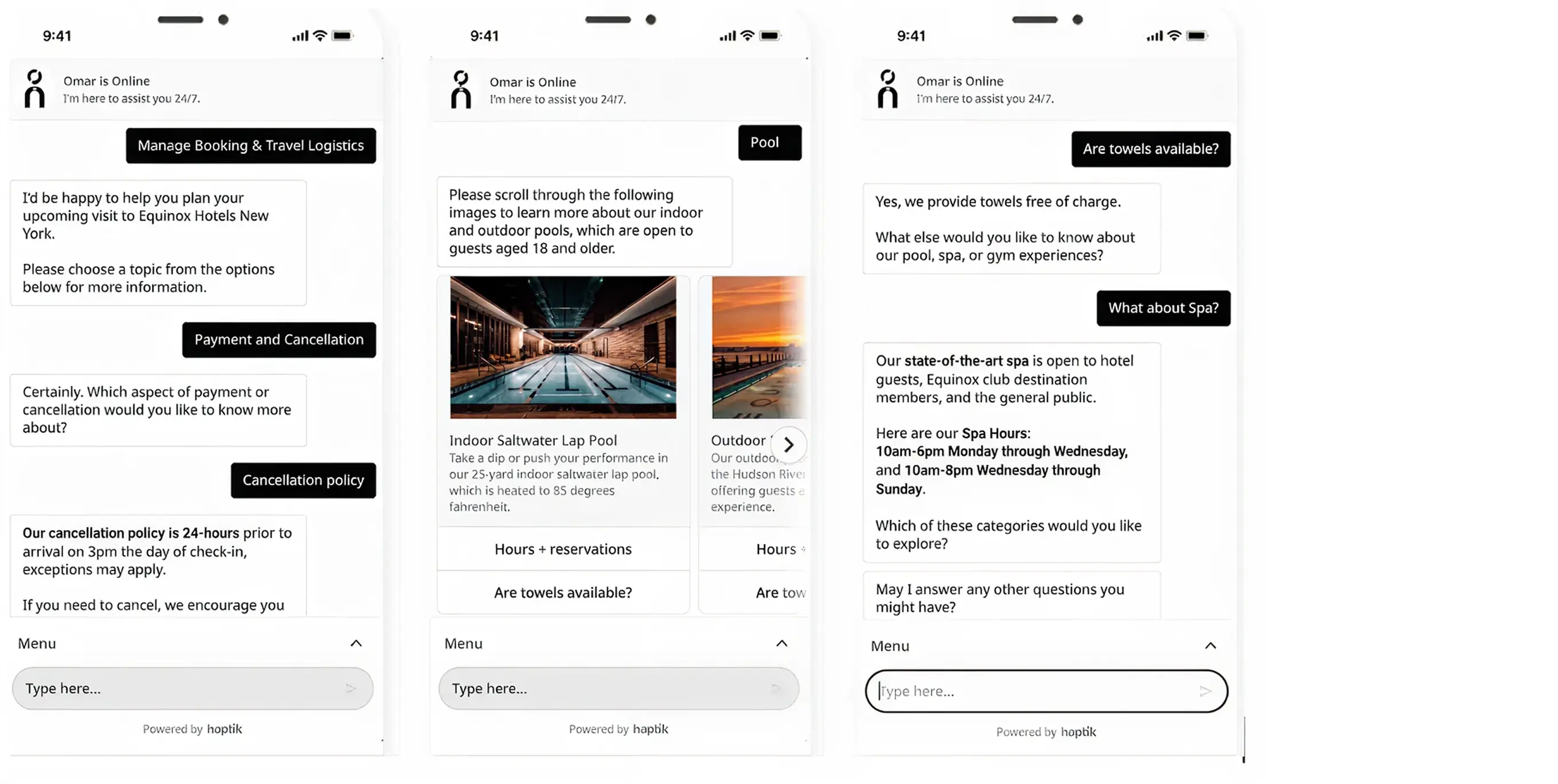
Like other industries, chatbots play a vital role in the hospitality industry. Chatbots take care of visitors' needs, book hotels, make reservations, guide visitors to local restaurants, and automate the payment process.
Hotels can then use these chatbots to cross-sell their services, such as salons, spas, and massages. This is possible through AI-powered chatbots.
4. Insurance Industry
Insurance Industry is another sector that is dependent on chatbots. Chatbots allow customers to upload documents. Insurance companies have deployed AI chatbots to help customers find specific information related to policies. Insurance chatbots solve customer queries by providing 24*7 customer support.
Whether to Go for Off-the-Shelf Solutions or Develop Custom Chatbots for Your Business?
You now understand how important it is for you to integrate a chatbot on your mobile app or website so that you can scale up your customer support, improve user engagement, and even guide prospects and move them down the buying journey.
But the question is, do you need to invest in custom chatbot development services or buy an off-the-shelf solution?
The answer lies in understanding the use case of your business, such as whether you want more customizability, the budget you have, and whether the chatbot is even scalable enough to manage more users or not.
Your Use case
Custom Chatbot Development
Off the Shelf Chatbot Solutions
1. Time to Set Up
Longer development cycle because you need to tell the developers and designers about all the features and functionalities you want the chatbot to have.
Quick deployment as these are plug-and-play chatbots, so you can integrate them on your mobile app in a few days or hours.
2. Customization
Wide range of customization options available.
For example, if you want a fitness chatbot that provides personalized workout plans for users, that sort of customization is possible using a custom chatbot, not a pre-built solution.
These chatbots are mostly plug-and-play, handle generic queries, and work the same for almost all industries and use cases.
No customization options are available.
3. Which is Budget friendly
Developing a custom chatbot for your business requires more development time and hence more cost, as it's perfectly designed to fit your workflows, your user needs, and your app goals.
These chatbots are used for generic use cases such as basic appointment booking, lead generation, or FAQ chatbots.
That's why they are cost-effective as they can be deployed faster. This makes them a good fit for small-scale startups who want to launch something quickly.
4. How much Does it Cost?
The cost of developing a custom chatbot can range between $5,000 - $50,000+.
Though you invest upfront, the value you get will be greater.
Generally, off-the-shelf chatbot solutions start with subscription-based pricing of $500/month and can go above that.
In the short run, it sounds affordable, but in the long run, it can become expensive depending on the features and functionalities you want.
5. Scalability
Custom chatbots should be scalable enough to support your business with a growing number of users.
Pre-built chatbots can't handle massive user queries and sudden spikes in traffic. Even if they do, they may lag after some time.
6. Which One Is Best for Me?
Your brand needs a lot of control over the chatbot, such as customizations as per your product flow and customers' journey.
You have a user base and want to solve simple queries; then an off-the-shelf solution can do the job.
P.S. - Need help in developing an off-the-shelf chatbot like WhatsApp?
How BigOhTech Can Help You Develop an AI Chatbot for Your Business?
As an AI development company, we create custom chatbot solutions for businesses in industries such as hospitality, ecommerce, and finance.
The chatbots we develop are scalable enough to support a growing number of transactions and can be integrated across platforms such as WhatsApp, Telegram, Facebook, and Messenger.
The client received 3,000+ complaints related to in-room stays, dining, and food orders, and for that, we integrated a chatbot on WhatsApp.
This not only provided a solution for handling guest queries but also freed up the front desk support team to focus on high-value tasks.
”
FAQs:
Q1. How can I Use Chatbots for My Business?
Chatbots provide various benefits to businesses -
Provides 24*7 support to customers
Increase customer engagement
Increase business sales
Provides personalized UX
Makes the lead generation process easy
Q2. What is the Difference Between Chatbots and Virtual Agents?
A chatbot is an AI software that can communicate with the customer, and its motto is to keep the conversation going.
Virtual agents, on the hand, are more than that. Virtual agents also use AI technology but have the skills to perform highly repetitive tasks. Virtual agents understand the intent of customers and then provide personalized responses.
Q3. Can Chatbots be used for E-Commerce?
Yes, chatbots can be used for e-commerce, and many e–commerce companies are using them to level up the game of conversational commerce.
Q4. Do Chatbots really Improve Conversions for My Business?
While for some businesses, it can work as a support tool, for others, it guides people through the steps, handles their simple to complex questions, and eventually lifts conversions.
In the case of the ecommerce industry, chatbots analyze customer behavior and preferences and then suggest personalized product recommendations based on what they like to buy.
These in-app chatbots can even provide a discount code or free shipping to move customers down the funnel.
But what if these questions aren't answered? People leave the site, increasing the bounce rate, and repetitive questions such as those about shipping, returns, availability, and basic product information go unanswered.
Q5. What are Some Common Challenges that My Business can Face While Integrating Chatbots into their Mobile Apps?
Here are a few concerns that every business owner has regarding the integration of chatbots in business workflows:
Raises data privacy concerns
Requires technical expertise as the integration process is difficult
Frustrates users if chatbots are not well-designed
Demands initial investment upfront in computing resources and data
Q6. How do I Integrate Chatbots into Mobile Apps as Seamlessly Possible?
Here are a few ways of making the integration process as smooth as a breeze:
Partner with technical experts, someone who's proficient in the chatbot integration process
Conduct user testing of the AI chatbot to see what features or functionalities affect the user experience
Always do a cost-benefit analysis to see how much ROI they can provide